Drought Update

efore anyone starts, this is not alarmist propaganda. This is information for you to do with how you want. I got a lot of feedback last year that I was trying to push some narrative with the drought updates because “it’s not dry at my house”. Well, honestly, it’s not dry at my house either. I’m not sure what the narrative is that I’m supposed to be pushing, but I dug a hole last week and 2 feet down, it filled with water, soooooo... I am just providing information.
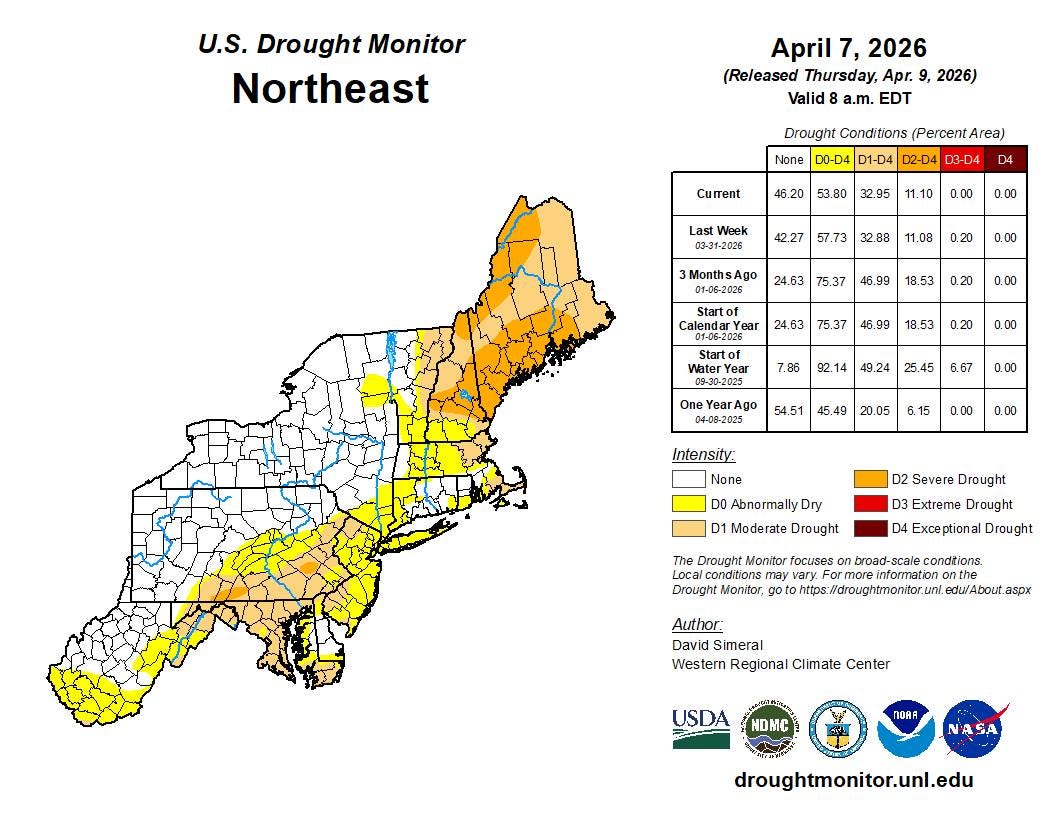
We are trending better. The snow melt and rainfall are helping, and conditions are improving, however, we are not out of the woods yet, and most of New Hampshire and all of Maine have quite a way to go. While this is an improvement, a hot, dry week is all it will take to tip the scales the opposite way.
What goes into the drought analysis? Good question, let me answer that for you. It is not one data set or a certain measuring instrument, but a lot of different extrapolated data sets. Obviously, precipitation and snow melt are a big part of this. Next, temperature and evaporation are figured into the equation. Soil moisture content is another major factor which also includes ground water. Well drilling companies typically have data on how deep a well had to be drilled before getting water. Stream and river flow rates and lake and pond levels are also calculated. While difficult to determine at this time of year, vegetation health is another big data point. Finally, direct reports regarding crop health, fire risk, water restrictions etc. All of this data is combined and compared to different standardized charts to come up with a determination as to how severe a drought it, and if a drought even exists. The whole “grocery store chains make it up so they can sell more bottled water” is a bunch of BS. There are people I know personally in northern New Hampshire whose wells went dry in September, and they are just now starting to see replenishment.